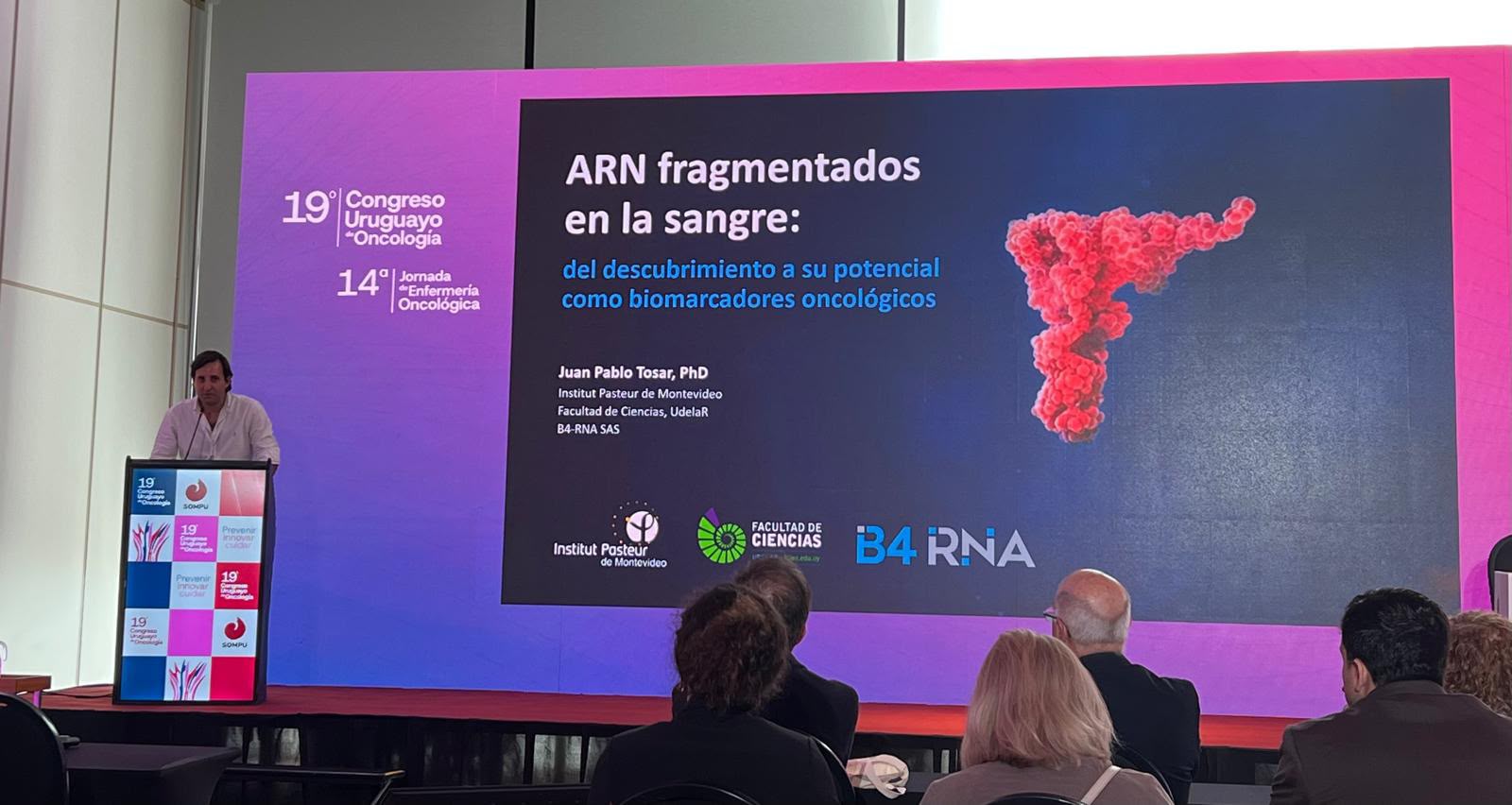
Punta del Este, Uruguay, November 27, 2026. B4-RNA, a biotechnology company developing next-generation extracellular RNA technologies for liquid biopsy and molecular diagnostics, today presented interim results from its ongoing prospective lung cancer study. Founder and Chief Scientific Officer Juan Pablo Tosar presented the data in an invited lecture at the 19th Uruguayan Congress of Oncology, drawing interest from oncologists from Uruguay and leading centers abroad.
The findings provide early clinical evidence that fragmented RNAs circulating in blood, once repaired with B4-RNA's proprietary, patent-pending REJOIN-seq™ technology, carry valuable diagnostic information. They also support cfRNA fragmentomics, a framework recently introduced by B4-RNA scientists in Trends in Biochemical Sciences, based on how the cutting, protection and clearance of circulating RNAs may reflect both the tumor and the body's response to it.
A clinically relevant prospective cohort
The study, conducted with Hospital Maciel in Montevideo, a national reference center for lung cancer in Uruguay, and Institut Pasteur de Montevideo, includes 103 participants: 48 lung cancer patients, 38 at-risk controls and 17 healthy volunteers.
The at-risk controls are recruited at the same hospital as the cancer patients and share characteristics of the population a lung cancer test would serve. They have a median smoking history of 45 pack-years, 41% have COPD, 22% have heart disease, and one in three has reduced performance status (ECOG ≥1). Including these controls helps assess whether the test detects cancer rather than simply poorer overall health.
The study incorporates key principles of the PRoBE framework for biomarker evaluation. Blood is collected prospectively under a single protocol and processed to serum, with patients and at-risk controls sampled at the same institution using identical tubes and handling procedures. Patients and controls were balanced across laboratory processing batches to minimize the risk of machine-learning models learning from technical rather than biological differences.
Diagnostic performance across multiple analytical approaches
Machine-learning models built on more than 2,000 RNA features per sample distinguished lung cancer patients from controls with an average library-level area under the curve (AUC) of 0.84 ± 0.02 across 20 random partitions of the cohort.
Patient-level five-fold cross-validation yielded an AUC of 0.91 (95% CI: 0.84–0.96) when five participants with recent major surgery were excluded from evaluation following a retrospective review of clinical records. Major surgery within two months of blood collection was a protocol-defined exclusion criterion. Applying the same exclusion to both training and evaluation yielded an AUC of 0.83, consistent with the average observed across repeated partitions.
In batch-held-out analyses, AUCs ranged from 0.75 to 0.88, reaching 0.83 and 0.88 in the two largest batches, which together included 34 of the 48 cancer patients. A model trained using cancer patients and at-risk controls correctly classified at least 80% of previously unseen healthy volunteers as cancer-free. A permutation test provided further evidence that the diagnostic signal was unlikely to arise by chance (p = 0.007).
Encouraging findings in early-stage disease and selected histologies
Exploratory analyses showed promising performance in detecting stage I and II lung cancers, although results varied across analyses and only ten early-stage cases were available. Larger cohorts will be needed to establish sensitivity in early-stage disease.
The signal was particularly strong in small-cell and neuroendocrine lung carcinomas, with cross-validated AUCs of 0.95 or higher. While exploratory and based on nine patients, most with advanced disease, this finding is of particular clinical interest given the limitations of low-dose CT screening in detecting small-cell lung cancer at an early stage.
Accessing a new class of circulating biomarkers
Among the most informative molecular features were repaired nicked tRNAs, molecules that circulate with their two halves still paired but are read as shorter, less informative fragments by conventional small RNA sequencing. Several of these features carry the molecular footprint of a cut at the anticodon, the exact site repaired by REJOIN-seq™. RNA fragments derived from transposable elements and other circulating non-coding RNAs, many of them also repairable with REJOIN-seq™, contributed to model performance.
From scientific discovery to clinical applications
We have known for years that blood is full of these fragmented RNAs. We now see that, once repaired, they carry real diagnostic information. What makes these results particularly meaningful is the clinical cohort: patients and controls with similar smoking histories and chronic conditions. We are encouraged by the preliminary results in early-stage disease and by the particularly strong signal in certain tumor histologies. Working side by side with oncologists has been key to this study from day one.
Juan Pablo Tosar, Founder and Chief Scientific Officer of B4-RNA
REJOIN-seq gives access to a class of circulating biomarkers that has so far been out of reach. Seeing it perform in a demanding clinical cohort strengthens our plans to take the platform to new applications and new partners.
Carlos Palma, Chief Executive Officer of B4-RNA
cfRNA fragmentomics looks beyond the small amount of RNA released by the tumor itself. The way circulating RNAs are cut and protected may also reflect the body's more abundant systemic response to the tumor, opening new possibilities for sensitivity. Other conditions can trigger a similar response, so specificity has to be earned through study design. That is why we compare patients with smokers who share their chronic conditions, and not with healthy donors alone.
Valentina Blanco, Scientist at B4-RNA and first author of the study and the Trends in Biochemical Sciences article
Next steps
Recruitment is ongoing. Following this pre-specified interim analysis, B4-RNA is working toward further evaluation on held-out samples, multicenter validation, expanded enrollment of patients with early-stage disease, and assessment of performance in the intended-use population of at-risk adults in outpatient settings.
B4-RNA expects to release a preprint describing the REJOIN-seq™ platform soon and plans to publish the full clinical results in a peer-reviewed journal.
This announcement describes preliminary research findings from a single-center pilot study that have not yet been peer reviewed or clinically validated. REJOIN-seq™ is currently intended for research use only.
About B4-RNA
B4-RNA is a biotechnology company based in Montevideo, Uruguay, developing next-generation extracellular RNA technologies for liquid biopsy and molecular diagnostics. Spun out of the Functional Genomics Laboratory at Institut Pasteur de Montevideo, the company develops REJOIN-seq™ as a platform for cfRNA fragmentomics, discovering and applying circulating RNA biomarkers in cancer and other diseases.
Selected scientific references
1. Costa B, Li Calzi M, Castellano M, Blanco V, Cuevasanta E, Litvan I, Ivanov P, Witwer K, Cayota A, Tosar JP. Nicked tRNAs are stable reservoirs of tRNA halves in cells and biofluids. Proceedings of the National Academy of Sciences U.S.A. 120(4) (2023). DOI: 10.1073/pnas.2216330120
2. Tosar JP, Castellano M, Costa B, et al. Small RNA structural biochemistry in a post-sequencing era. Nature Protocols 19, 595–602 (2024). DOI: 10.1038/s41596-023-00936-2
3. Blanco V, Castellano M, Tosar JP. Cell-free RNA fragmentomics: rethinking the biology of RNA liquid biopsies. Trends in Biochemical Sciences (2026). DOI: 10.1016/j.tibs.2026.09.007